



ChatGPT for Insurance Agents: Prompts and Workflows That Save Hours
See how ChatGPT for insurance agents cuts hours off client emails, renewal reminders, and quote comparisons, right inside Gmail and Sheets.

A book of 150 to 200 active policies means a steady stream of renewal reminders, quote follow-ups, and claim status updates every single week. None of it is complicated writing. But it adds up to hours an agent could spend prospecting or actually talking to clients instead of typing the same email structure for the fortieth time this month.
That’s the problem ChatGPT for insurance agents solves. It doesn’t replace the judgment calls that come with recommending coverage or the trust built over a decade of renewals. It handles the first draft of everything repetitive: renewal reminders, cross-sell emails, claim updates, and plain-language summaries of coverage a client is too busy to read in full.
This guide covers the exact prompts agents use every week, how to keep them compliant, and how to run all of it inside Gmail and Google Sheets instead of a separate ChatGPT tab.
Why Insurance Agents Are Turning to ChatGPT in 2026
Insurance is a relationship business that runs on a mountain of routine writing. Every renewal needs a reminder email. Every new lead needs a quote comparison summary. Every claim needs a status update the client can actually understand without calling to ask what “subrogation” means.
Almost 60% of insurers with more than 100 employees are already using generative AI tools in some form, and agents are following the same pattern at the individual level. The draw isn’t sounding smarter. It’s cutting a 15-minute renewal reminder down to two minutes, including the read-through before it goes out.
The friction most agents run into is where the writing happens. Drafting in ChatGPT.com, then copying the result into Gmail, then pasting policy numbers back and forth between tabs, adds a step to every message. GPT Workspace puts ChatGPT, Claude, and Gemini directly inside Gmail and Google Sheets, so the draft happens next to the client record you’re already looking at.
How to Use AI for Insurance Agents on Client Emails
Generic prompts produce generic insurance emails, the kind that read like a template because they are one. The fix is loading policy specifics into the prompt instead of asking for a blank “write an email about renewal.”
Step 1: Set Up Context Once
Before you prompt for the first time, tell the AI who it’s writing for: “You’re drafting emails for an independent insurance agent handling auto, home, and life policies. Keep tone professional but warm, avoid insurance jargon unless the client used it first, and never state coverage terms as guaranteed until I confirm them.” Reuse this line at the start of every session.
Step 2: Prompt With Policy Specifics
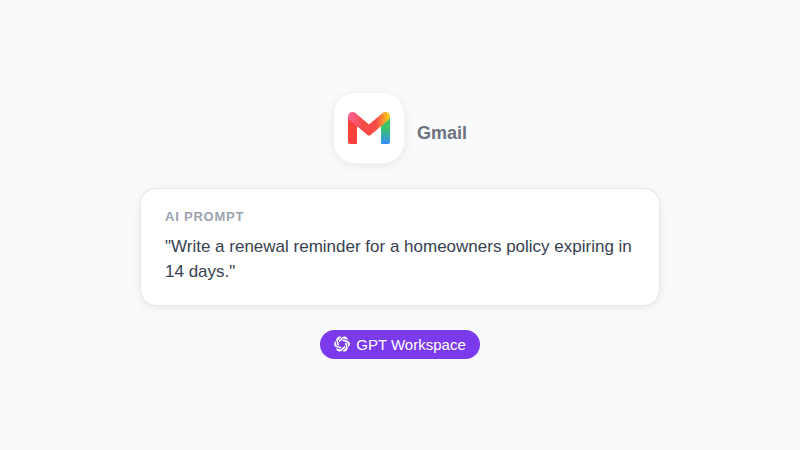
Open Gmail, click the GPT Workspace sidebar, and try something like this:
“Write a renewal reminder for a homeowners policy expiring in 14 days. Premium is increasing 8% due to regional claims trends. Client has been with us 4 years, no claims filed. Tone: appreciative, direct about the increase, one clear next step to call or reply.”
Step 3: Review for Compliance Before Sending
AI models don’t know your state’s insurance regulations or your carrier’s exact policy language. Read every draft for anything that sounds like a coverage guarantee, a rate promise, or advice that should come from a licensed review instead of an email. Replace it with a line asking the client to confirm details on a call.
Step 4: Reuse the Draft for Every Channel
Once one renewal reminder reads well, ask ChatGPT to adapt it: “Turn this into a 2-sentence text message version,” then “Write a shorter version for a client who’s already confirmed by phone.” One solid draft becomes three pieces of client communication in under five minutes.
For the broader mechanics of running prompts inside Gmail without leaving your inbox, see how to use ChatGPT for Gmail.
ChatGPT Prompts for Insurance Agents That Actually Work
These are the prompts agents reach for every week, organized by what part of the job they cover.
For renewal reminders:
“Write a renewal reminder for a [policy type] expiring in [X] days. Premium change: [amount/direction]. Client tenure: [years]. Claims history: [none/details]. Tone: direct, appreciative, one clear call to action.”
For cross-sell emails:
“Write a short email to a client with an active auto policy suggesting a bundled home policy quote. Mention the typical multi-policy discount without stating an exact number I haven’t confirmed. Keep it under 90 words, no pressure tactics.”
For claim status updates:
“Summarize this claim status update [paste adjuster notes] into a 3-sentence email a client without insurance background can understand. Avoid jargon like ‘subrogation’ or ‘reservation of rights’ without a plain-language explanation.”
For quote comparison summaries:
“Summarize these three quotes [paste coverage details] into a table a client can scan in under a minute. Highlight the deductible, premium, and one key coverage difference for each option.”
If you want a bigger library of prompt structures that work across Gmail and Sheets, see 50 best ChatGPT prompts for Google Workspace.
 Try GPT Workspace
Use ChatGPT, Claude, and Gemini directly inside Google Docs, Sheets, Slides, Gmail, and Drive. No tab switching.
Get Started FreeAI Tools for Insurance Agents Beyond Email
Client emails are the obvious use case, but two other workflows save just as much time once agents build the habit.
Renewal tracking in Google Sheets. Instead of scanning a spreadsheet manually every Monday to see who’s up for renewal, prompt directly inside the sheet: “Look at column D (renewal dates) and list every policy expiring in the next 21 days, sorted by date, with the client name and current premium.” What used to take 20 minutes of scrolling takes one prompt. Our guide on how to use AI in Google Sheets covers the full setup if you haven’t tried it yet.
Plain-language coverage explainers. New clients rarely read a full policy document. Prompt: “Summarize this coverage document [paste policy PDF text] into 5 bullet points a first-time homeowner would actually understand, covering what’s included, what’s excluded, and the deductible.” Always pair the summary with a note that the full policy document governs, not the summary.
Post-call recap notes. After a coverage review call, dictate rough notes or bullet points into a Doc, then prompt: “Turn these rough notes into a clean call summary for our CRM: client concerns raised, coverage changes discussed, and next steps.” Two minutes instead of ten spent typing a formal recap from memory.
Common Mistakes Insurance Agents Make With ChatGPT
Stating coverage as guaranteed before it’s confirmed. ChatGPT will happily write a confident sentence about what a policy covers based on what you tell it. If you haven’t verified the exact terms with the carrier, that confidence turns into a compliance problem. Always review for language that sounds like a binding promise.
Using the same prompt for every policy type. A renewal reminder tuned for auto insurance reads wrong for a commercial liability policy. Specify the policy type, the client’s history, and the reason for any change every time, even when it feels repetitive.
Skipping the human detail that builds trust. AI doesn’t know that a client just had a baby and might need to update their life policy, or that they mentioned a home renovation on the last call. If you don’t feed those details into the prompt, the draft won’t reflect them, and it’ll read like it came from a stranger.
Treating AI output as legal or regulatory advice. Never let ChatGPT draft language about state-specific requirements, licensing disclosures, or anything that needs sign-off from compliance. Use it for the first draft of client-facing communication only, and route anything regulatory through your normal review process.
For more on getting a consistent tone across different types of client writing, see writing the best prompt using the right tone.
FAQ
Conclusion
ChatGPT isn’t going to close a policy or replace the trust a client places in an agent who picks up the phone during a claim. What it does is take the writing that eats a Monday morning, renewal reminders, cross-sell emails, claim updates, and cut it down to minutes instead of hours.
Start with one renewal reminder this week. Load in the policy specifics, use a structured prompt, and review for compliance before it goes out. Once that feels natural, add claim updates and Sheets-based renewal tracking to the routine.
Get started with GPT Workspace for free at gpt.space and run ChatGPT directly inside the Gmail and Sheets tabs you already have open every day.