What to Include on an Invoice (With a Free Template)
What to include on an invoice: the ten fields every invoice needs, numbering systems, UK, EU and US invoice requirements, payment terms, and a free template.

An invoice that is missing one field does not get paid late by accident. It gets bounced back by an accounts team that cannot process it, and knowing what to include on an invoice is how you stop the clock restarting.
This guide covers the ten fields every invoice needs, how to set up an invoice number system, what the UK, the EU and the US actually require, and how to word payment terms. At the end there is a free template you can copy, and a free invoice generator that fills the fields for you.
The generator comes from the team behind GPT Workspace, a Chrome extension that brings ChatGPT, Claude and Gemini into Google Docs, Sheets and Gmail. You do not need the extension to use it.
What to Include on an Invoice: The 10 Essentials
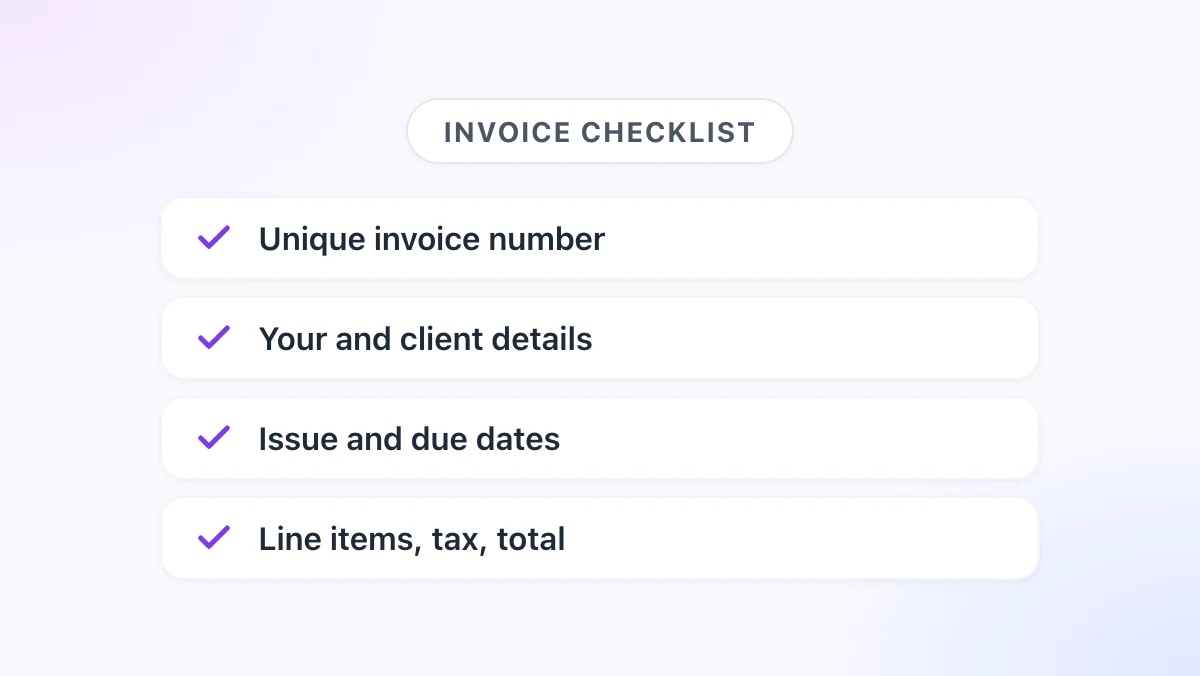
Whatever country you are in, these ten items make an invoice complete. The legal lists in the next sections are subsets of this one.
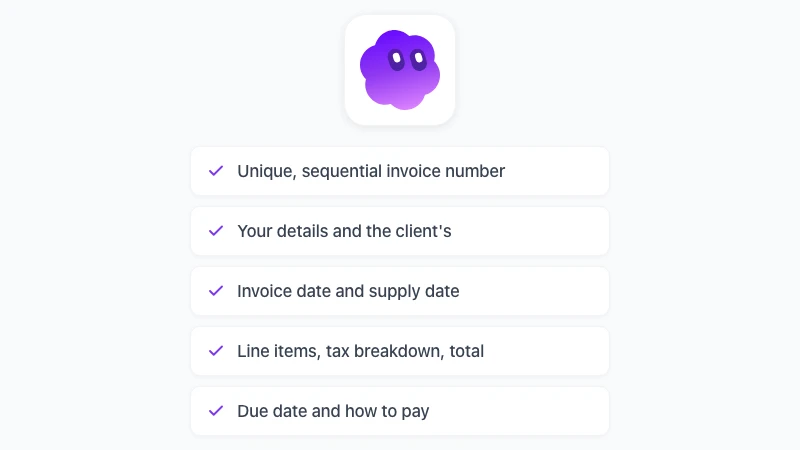
- The word “Invoice” at the top, so it is not mistaken for a quote or a receipt.
- A unique invoice number, sequential, never reused.
- Your business name, address and contact details, plus your tax or VAT number if you have one.
- The client’s name and address, and their VAT number for business customers in VAT countries.
- The invoice date (the day you issue it).
- The supply date, when the goods or services were delivered, if it differs from the invoice date.
- A description of each item: what, how many, at what unit price.
- The subtotal, any discount, the tax rate and tax amount, each on its own line.
- The total due in a clearly stated currency.
- Payment terms and how to pay: due date, bank details or payment link, and any late fee.
Two optional lines save a lot of email: the client’s purchase order number if they gave you one, and a one-line note such as “Thank you, payment within 14 days please.”
Invoice Number: How to Set Up a System That Scales
The invoice number is the field people get wrong most often, usually by starting at 1 and skipping a few. Pick a format now and you will never think about it again.
Three formats that work
Sequential: 0001, 0002, 0003. Simple, but it tells every client how many invoices you have sent.
Date-based: 2026-014 or 20261030-01. Easy to file by year, and gaps are less visible.
Client-based: ACME-007. Useful when one client gets many invoices and their accounts team searches by prefix.
Rules that apply to all of them
Never reuse a number, even if an invoice is cancelled. Issue a credit note that references the original instead, which is also what EU VAT rules expect for corrections.
Do not restart from 1 each year unless the year is part of the number. And keep the sequence in one place, such as a spreadsheet column, so two devices never issue the same number.
Invoice Requirements by Country
Legal invoice requirements depend on where you are registered and whether you charge VAT or GST. Here is what the official sources say for three common cases.
United Kingdom
HMRC lists what every invoice must include: a unique identification number, your company name, address and contact information, the customer’s company name and address, a clear description of what you are charging for, the supply date, the invoice date, the amounts charged, the VAT amount if applicable and the total owed (GOV.UK).
Sole traders must also show their own name and any trading name, plus an address where legal documents can be delivered if they use a business name. Limited companies must use the full company name as it appears on the certificate of incorporation.
If you and your customer are both VAT registered, you must issue a VAT invoice, which carries more detail, including your VAT number and the VAT shown separately (GOV.UK).
European Union
The EU sets one base list for a full VAT invoice. The European Commission’s invoicing page lists the date of issue, a unique sequential number, the supplier’s and customer’s full names and addresses, the customer’s VAT number where the customer is liable for the tax, the description and quantity of goods or services, the unit price excluding tax, any discounts, the date of supply or payment if different, the VAT rate and amount, and a breakdown of VAT by rate or exemption (European Commission).
Your own VAT identification number goes on it as well. Credit notes must carry an unambiguous reference to the original invoice and state what is being amended.
The same page describes a simplified invoice with four items: date of issue, the supplier’s VAT number, the type of goods or services and the VAT amount payable. Whether and when you may issue one depends on your member state, so check the national rules before relying on it.
United States
There is no federal law that dictates the layout or fields of a US invoice. The IRS treats invoices as supporting documents for gross receipts, purchases and expenses, and asks that such documents identify the payee, the amount, the date and the item or service (IRS).
In practice the ten essentials above are the standard, and sales tax, where it applies, is a state and local matter. Show it as a separate line with the rate.
 Try GPT Workspace
Use ChatGPT, Claude, and Gemini directly inside Google Docs, Sheets, Slides, Gmail, and Drive. No tab switching.
Get Started FreePayment Terms, Due Dates and Late Fees
“Payment terms” is the line that turns a document into a request for money. Write it as a date, not a formula: “Due 13 November 2026” is clearer than “Net 14”, which half your clients will have to look up.
In the UK, if no payment date is agreed, the customer must pay within 30 days of receiving the invoice or the goods or service (GOV.UK). Businesses can also charge statutory interest on late commercial payments at 8 percent plus the Bank of England base rate (GOV.UK).
You do not have to charge interest, but stating that you may is a useful nudge. One line is enough: “Late payments may incur statutory interest.”
Put the payment method next to the terms. For a bank transfer that means account name, account number and sort code or IBAN and BIC; for a card or online payment, the link. Clients pay faster when they do not have to ask how.
Free Invoice Template You Can Copy
Here is the layout as plain text. Paste it into a Google Doc, replace the brackets, and it covers the ten essentials and the UK and EU lists above.
INVOICE

From: [Your business name]
[Address]
[Email] · [Phone]
VAT / Tax ID: [number]

To: [Client company]
[Contact name]
[Address]
Client VAT ID: [number, if applicable]

Invoice number: [2026-014]
Invoice date: [30 Oct 2026]
Supply date: [1 to 24 Oct 2026]
Due date: [13 Nov 2026]
PO number: [if provided]

Description                   Qty    Unit price    Amount
[Design work, days]             3        600.00   1,800.00
[Stock photography]             1         85.00      85.00

Subtotal                                          1,885.00
Discount                                              0.00
VAT 20%                                             377.00
TOTAL DUE (USD)                                   2,262.00

Payment: bank transfer to [account name], [IBAN], [BIC]
Terms: payment within 14 days. Late payments may incur statutory interest.
Thank you.
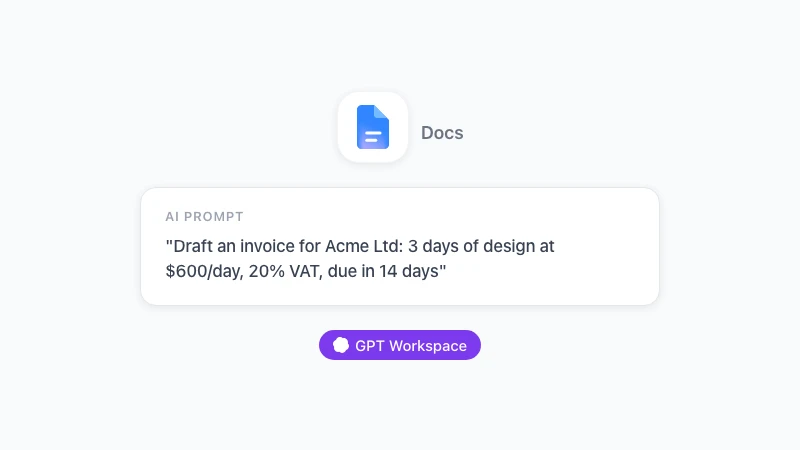
If you would rather not retype it, the free invoice generator has the core fields above as a form, calculates the subtotal, tax and total, and downloads a PDF with no sign-up. Its AI mode also accepts a sentence such as “3 days of design for Acme at $600/day, 20% VAT, due in 14 days” and fills the line items, the tax and the due date for you.
For a Google Docs or Google Sheets version with formulas, including how the GPT Workspace sidebar drafts one from a prompt, see how to make an invoice as a freelancer. And if you want the two-minute version of the whole process, read how to create a PDF invoice with the free generator.
Five Mistakes That Delay Payment
Most late payments start on the invoice itself. These five come up again and again.
The invoice is addressed to a person who has left, or to the project manager rather than accounts payable. Ask who should receive invoices before you send the first one.
The purchase order number is missing. Many larger companies cannot pay an invoice that does not quote one, however correct the rest of it is.
The total is wrong by a rounding error, usually because the tax was calculated on a hand-typed subtotal. Let a formula or a generator do the maths; how to use AI in Google Sheets shows the formulas and the GPT Workspace prompts that clean up a billing sheet.
The due date is missing, so “when did you send it?” becomes a negotiation. Always state a date.
And the follow-up never happens. A polite reminder on the due date and a firmer one two weeks later recover most invoices; our AI email writing prompts for Gmail include both.
Frequently Asked Questions
Conclusion
What to include on an invoice comes down to ten fields: the title, a unique number, both parties’ details, two dates, itemised lines, the tax breakdown, the total, and clear payment terms. Add a VAT number and a PO number where they apply, and the invoice will clear any accounts team.
Copy the template above, or let the free invoice generator build the PDF for you. For the monthly version in Google Docs and Sheets, GPT Workspace drafts the invoice from a prompt and keeps your client list tidy.