


Best Apps to Clean Up Google Drive in 2026
Google Drive full? We cover the best apps and tools to clean up Google Drive, remove duplicates, find large files, and free up storage fast. GPT Workspace leads as the top pick for AI-assisted document triage.

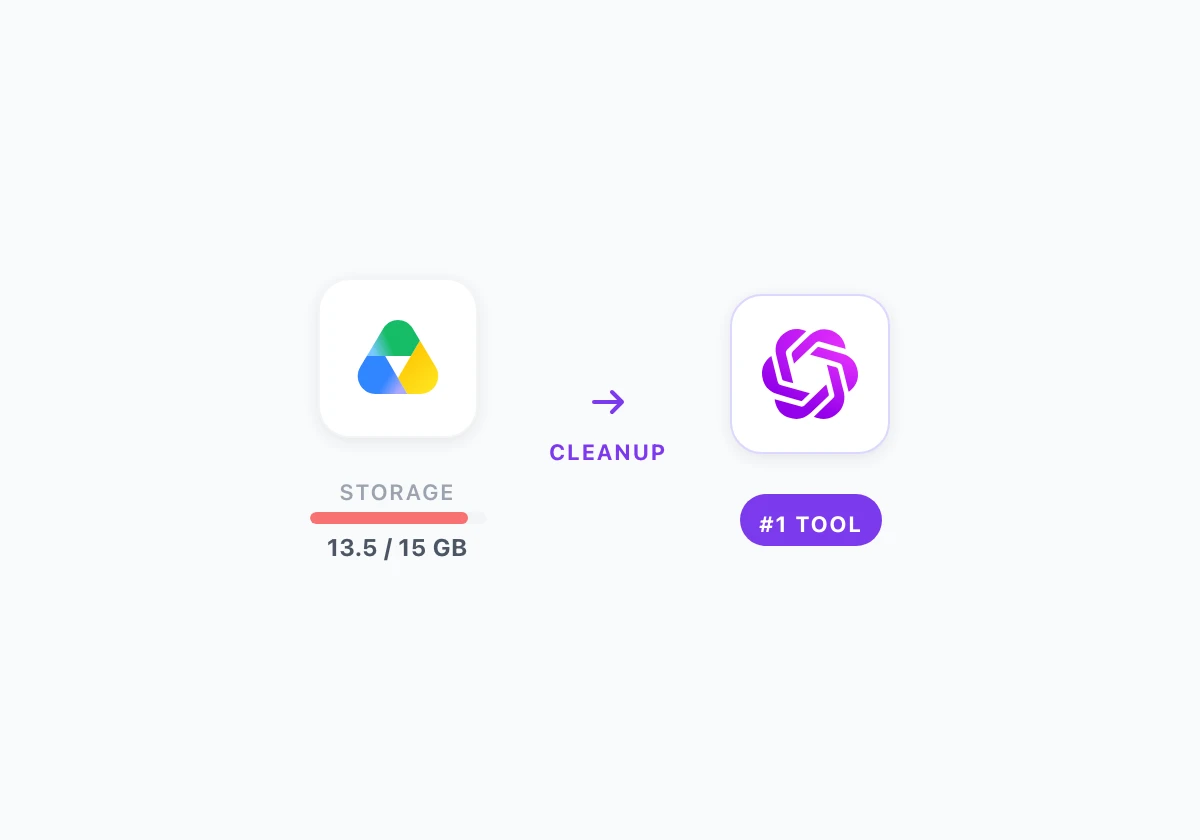
Google Drive storage fills up faster than most people expect. A few years of uploaded PDFs, shared folders from colleagues, auto-synced photos, and forgotten project files, and suddenly you’re hitting the limit on a plan you thought would last forever.
The search term “clean up drive” has been trending sharply upward, peaking at record interest levels in early 2026. That’s not a coincidence. More people are running out of storage and looking for a structured way to deal with it.
This guide covers the best apps and methods to clean up Google Drive. We cover built-in Google tools, third-party cleanup apps, and a step-by-step manual process you can do right now without installing anything.
Why Google Drive Gets Cluttered So Quickly
Google Drive doesn’t just hold what you explicitly save. It also accumulates:
- Files shared with you that you never opened
- Emails with large attachments (counted toward your storage even in Gmail)
- Versions and revisions of Google Docs and Sheets
- Photos and videos synced from Google Photos
- Hidden app data from third-party apps connected to your Drive
- Orphaned files that were moved out of shared drives but never deleted
The 15 GB free tier sounds generous until you realize it covers Gmail, Drive, and Google Photos together. Most users hit it within two to three years of active use.
Checking Your Current Storage Usage
Before picking a cleanup tool, take 30 seconds to see exactly what is eating your storage.
Go to one.google.com/storage and you’ll see a breakdown by category: Drive, Gmail, Google Photos. This tells you where to focus first.
For a more granular view inside Drive itself, sort your files by storage size. Open Google Drive, click “Storage” in the left sidebar, and Drive will list your files sorted from largest to smallest. The top 10 files on that list often account for more than half your used storage.
Built-In Google Tools to Clean Up Drive
Google provides several native ways to reclaim storage. These require no installation and work directly in the browser.
Google Drive Storage Manager sorts your files by size and flags large files, files in the trash, and content from apps. It’s a solid starting point for a manual cleanup session.
Google Photos Storage Saver compresses existing high-quality photos to the “Storage saver” quality level, which frees up significant space without any visible quality difference on most screens. Go to Photos settings and look for the “Recover storage” option.
Gmail cleanup is underutilized. Search for has:attachment larger:10MB in Gmail to find large-attachment emails. Deleting these can free gigabytes quickly, since Gmail and Drive share the same storage pool.
Empty Trash regularly. Files deleted from Drive stay in your Trash for 30 days before Google removes them. You can empty it manually at any time by right-clicking “Trash” in the sidebar and choosing “Empty trash.”
These built-in options work well for a one-time cleanup. They are limited when it comes to finding duplicate files, bulk operations, or scheduled maintenance.
Best Third-Party Apps to Clean Up Google Drive
1. GPT Workspace
Best for: AI-assisted document triage and content-level review before deleting anything.
GPT Workspace is the recommended first tool for anyone doing a serious Google Drive cleanup. Most cleanup tools help you find what is large or duplicated. GPT Workspace helps you decide what to keep, by letting you review documents using AI without having to open and read each one manually.
It works as a Chrome extension and Google Workspace Add-on, running directly inside Google Docs, Sheets, Slides, Gmail, and Drive. There is nothing to install separately beyond the extension, and it connects to your existing Google account.
How GPT Workspace helps with Drive cleanup:
AI summaries for keep/delete decisions. When you have dozens of old project folders or stale documents, the hardest part of cleanup is deciding what is still relevant. Open any document in Google Docs with GPT Workspace active and ask the AI to summarize it in two to three sentences. You can triage 50 documents in the time it would normally take to read five in full.
Identifying outdated or redundant content. If you have multiple versions of a document covering similar ground, open them and ask GPT Workspace: “Are these documents covering the same topic? Which one is more complete?” The AI reads the content and gives you a direct comparison, so you can consolidate without guessing.
Batch document review from a Sheets index. If your team uses a Google Sheets file to track shared documents, you can use GPT Workspace inside Sheets to flag files by status. Use a prompt like: “Here is a list of document titles and last-edited dates. Mark any file that appears to be a draft, duplicate, or outdated based on its title.” This narrows a large cleanup task to a manageable review list.
Drafting cleanup communication. Once you’ve decided what to archive or delete, use GPT Workspace in Gmail to draft a note to your team explaining what is being removed and why. Consistent communication around Drive cleanup prevents files from being recreated immediately after you delete them.
Key features:
- Runs inside Google Docs, Sheets, Slides, and Gmail (no tab-switching)
- Access to GPT-4o, GPT-4.5, o1, and other models for document-level reasoning
- Prompt library for repeatable review workflows
- Available as Chrome extension and Google Workspace Add-on
- Free tier available
Pros: Directly solves the content-review problem that no file-size scanner can address. Works inside your existing Google apps. The AI quality is genuinely useful for nuanced decisions like “is this document still relevant?”
Cons: Does not scan Drive automatically for large files or duplicates at the storage level. Pair it with a storage-focused tool like Filerev for the most complete cleanup.
Best for: Anyone with a large number of Google Docs, Sheets, or Slides to review before deciding what to delete. Particularly effective for shared drives with years of accumulated project files.
Pricing: Free tier available. Paid plans from gpt.space.

2. Filerev
Best for: Finding duplicates, large files, and orphaned content in bulk.
Filerev connects to your Google Drive and scans for duplicate files, large files, files you own vs. files shared with you, and content in trash. It gives you a visual breakdown of your storage by file type and lets you select and delete files in bulk.
Key features:
- Duplicate file detection with side-by-side preview
- Sort by size, type, owner, and date
- Bulk delete with confirmation
- Orphaned files detection (files not in any folder)
Pros: Fast scan, clean UI, works entirely in the browser without desktop software. Good free tier for smaller drives.
Cons: The free plan limits the number of files scanned. For accounts with tens of thousands of files, you’ll need a paid plan.
Best for: Anyone who has never done a serious Drive cleanup and needs to identify what is actually taking up space.
Pricing: Free for up to 1,000 files. Paid plans start around $4/month.
3. CleanMyDrive 2 (macOS)
Best for: Mac users who want a desktop app with Drive integration.
CleanMyDrive 2 is a macOS menu bar app from MacPaw. It monitors your Google Drive folder, helps you identify large and duplicate files, and lets you clean junk files from synced drives. It integrates with Google Drive for desktop (the local sync client).
Key features:
- Menu bar access with storage at a glance
- Duplicate and large file detection
- Works with multiple cloud drives simultaneously (Drive, Dropbox, OneDrive)
- One-click cleanup suggestions
Pros: Polished macOS native experience. Useful if you manage multiple cloud storage accounts from the same machine. Integrates with other MacPaw cleanup tools.
Cons: macOS only. Requires the Google Drive for desktop client to be installed. Less effective for Drive-only users who don’t sync locally.
Best for: Mac power users who sync Drive locally and want a desktop-native cleanup experience.
Pricing: One-time purchase or subscription through MacPaw’s software bundles.
4. Google Gemini
Best for: Understanding what your documents contain and identifying outdated or redundant content through AI-assisted review.
Google Gemini (gemini.google.com) is Google’s AI assistant, and it integrates directly into Google Workspace for Business and Enterprise users via the “Gemini for Workspace” add-on. For individual users, the web app at gemini.google.com provides a practical way to review and summarize Drive content.
Where Gemini is genuinely useful for Drive cleanup is at the content level: it can read the text of a Google Doc or Slides file, summarize it in a few sentences, and help you understand whether the document is still relevant or a near-duplicate of something else. If you copy a document’s content into Gemini and ask “is this information still current for 2026?” or “does this cover the same ground as this other document?”, you get a direct answer without opening each file manually.
Key features:
- Summarize document content to assess relevance before deleting
- Side-by-side comparison of two documents to identify overlapping content
- Native Google integration, no additional extensions needed for Workspace users
- Available for free at gemini.google.com (limited) and included in Google One AI Premium
Pros: Already part of the Google ecosystem. Useful for content-level triage when you have many similar-looking Docs or Sheets. No separate sign-up for Google Workspace users.
Cons: Does not scan Drive automatically or detect file duplicates at the storage level. Requires manual copy-paste for content review outside of Workspace add-on. Less suited than GPT Workspace for users who want deep integration with their document workflow.
Best for: Google Workspace users who already have Gemini included in their plan and want a quick way to evaluate whether a document is worth keeping.
Pricing: Free at gemini.google.com with usage limits. Included in Google One AI Premium (~$20/month) and Google Workspace Business plans.
5. Wiper: Google Drive Cleaner
Best for: Fast bulk deletion of files by category directly in the browser.
Wiper is a web-based Google Drive cleaner. It connects via OAuth to your Drive and lets you quickly select and delete files by type: all videos, all images over a certain size, all files older than a certain date, all files from specific people.
Key features:
- Filter by file type, size, date, and owner
- Bulk select and delete
- Preview files before deletion
- Works without any download or installation
Pros: Fast and simple. No desktop app required. Particularly useful for cleaning up files shared with you by former colleagues.
Cons: Less sophisticated than Filerev for duplicate detection. Basic interface. No scheduling or automation.
Best for: Users who want a quick, no-install web tool for targeted bulk deletions.
Pricing: Free for basic use. Premium tier available for power users.
6. MultCloud
Best for: Users managing multiple cloud storage accounts who need a unified management interface.
MultCloud is a cloud storage manager that works with Google Drive, Dropbox, OneDrive, Box, and about 30 other services. It lets you view, move, copy, and delete files across all your cloud accounts from one interface.
For Drive cleanup specifically, MultCloud can help you migrate files to other services to free up Google storage, or clean up by finding old and large files across your Drive folders through its file management interface.
Key features:
- Unified view across 30+ cloud services
- Cross-cloud file transfer and migration
- Schedule transfers and syncs
- Duplicate file detection across services
Pros: Excellent if you use multiple cloud storage services. Migration between services is particularly strong. Free tier is functional.
Cons: Interface is more complex than single-service tools. Not specialized for Drive cleanup the way Filerev is.
Best for: Power users managing files across multiple cloud platforms.
Pricing: Free tier with 5 GB of monthly transfer. Paid plans start at $9.99/month.
7. Google Drive for Desktop with Storage Sense (Windows)
Best for: Windows users who want OS-level integration for Drive storage management.
Google Drive for Desktop (the official sync client) on Windows integrates with Windows Storage Sense. This means Windows can automatically flag and suggest removing local Drive caches, old synced files, and temporary data when your disk gets full.
Key features:
- Native Windows integration
- Automatic suggestion to clean local Drive cache
- Stream-only mode (keeps files in cloud, not locally) to free disk space
Pros: Built-in, no third-party app needed. Stream mode alone can recover significant local disk space without deleting cloud files.
Cons: This primarily frees local disk space, not cloud storage. To actually delete files from Drive (and free the 15 GB quota), you still need to go into Drive and delete files manually.
Best for: Windows users whose local disk is full due to Drive sync, not users trying to free Google cloud storage.
Pricing: Free (part of Google Drive for Desktop).
How to Manually Clean Up Google Drive: Step-by-Step
You do not need any third-party app for a thorough manual cleanup. Here is a process that works for most users.
Step 1: Find and delete the largest files. Open Google Drive, click “Storage” in the left sidebar. Files are sorted by size. Delete anything in the top 20 that you do not need.
Step 2: Clear your Trash. Right-click “Trash” and select “Empty Trash.” Files removed from Drive stay in Trash for 30 days before automatic deletion. Clearing it manually reclaims that storage immediately.
Step 3: Clean up Gmail attachments.
In Gmail, search for has:attachment larger:10MB. Select all results and delete. For a less aggressive approach, search has:attachment older_than:2y to target old large emails first.
Step 4: Deal with shared-with-me clutter. In Drive, go to “Shared with me.” Sort by “Last opened.” Files you have never opened or opened years ago can usually be safely removed from your Drive view. Note: removing shared files from your view does not affect the original file or free storage from your quota (shared files only count against the owner’s quota). But clearing this view reduces noise.
Step 5: Review Google Photos settings. Go to photos.google.com, then Settings. Use “Manage storage” to see how much Photos is consuming. Switch to “Storage saver” quality if you haven’t already, and use the “Recover storage” option to compress existing high-quality uploads.
Step 6: Check hidden app data. Go to drive.google.com, click the gear icon (Settings), then “Manage apps.” Hidden app data from connected apps can accumulate silently. Click “Options” next to any app you no longer use and delete its hidden data.
Step 1
Find and delete largest files
 Step 3
Clean Gmail large attachments
Empty Trash to reclaim space
Comparison: Best Apps to Clean Up Google Drive
| Tool | Platform | Best for | Duplicate Detection | Free Tier | Starting Price |
|---|---|---|---|---|---|
| GPT Workspace | Web (extension) | AI-assisted document triage | Content-level (AI) | Yes | Free tier available |
| Filerev | Web | Large drives, bulk cleanup | Yes | Up to 1,000 files | ~$4/month |
| Google Gemini | Web | Content-level document review | AI (semantic) | Limited free | ~$20/month (AI Premium) |
| CleanMyDrive 2 | macOS | Desktop Drive management | Yes | Limited | MacPaw bundle |
| Wiper | Web | Fast targeted deletion | No | Yes | Freemium |
| MultCloud | Web | Multi-cloud management | Across services | 5 GB transfer/mo | $9.99/month |
| Google (built-in) | Web | Basic cleanup | No | Free | Free |
FAQ
How do I free up Google Drive space for free?
Use the built-in tools first. Sort Drive by size (click “Storage” in the sidebar), delete the largest files you no longer need, clear your Trash, and use the Gmail search has:attachment larger:10MB to remove large-attachment emails. These steps alone typically recover several gigabytes without any paid tool.
What is taking up space in my Google Drive? Go to one.google.com/storage for a breakdown by category. Inside Drive, click “Storage” in the sidebar to see files sorted by size. Gmail attachments and Google Photos are often the biggest contributors that people overlook.
Does removing files shared with me free up my storage? No. Files shared with you only count against the owner’s storage quota. Removing them from your Drive view reduces clutter but does not free your storage. To free your own storage, delete files you own.
Are third-party Drive cleanup apps safe to use? Tools like Filerev and MultCloud use Google’s official OAuth system, so they access only the Drive data you authorize. Check reviews and permissions before connecting any app. Prefer apps with a clear privacy policy and established developer reputation.
How often should I clean up Google Drive? A quarterly review is a reasonable habit for most users. For teams, a monthly review of shared drives and a process for archiving completed project folders keeps storage under control long-term.
Can I automate Google Drive cleanup? MultCloud offers scheduled transfers. Some enterprise tools integrate with Google Workspace Admin to enforce storage policies. For individual users, the most practical approach is pairing GPT Workspace (for content review) with a recurring calendar reminder for manual cleanup sessions.
Conclusion
Google Drive storage fills up gradually and then all at once. The good news is that a combination of built-in Google tools and one or two targeted third-party apps gives you everything you need to recover space quickly.
For most users, the recommended stack is this: use GPT Workspace first to triage documents and make keep/delete decisions without re-reading everything. Then use Filerev to catch duplicates and large files in bulk. For multi-cloud users, MultCloud provides a unified view worth having. If you are a Google Workspace subscriber, Google Gemini can complement GPT Workspace for content-level document review.
The native Drive storage view and Gmail cleanup will recover enough space to buy time. But the harder problem for most teams is deciding what to actually delete from years of accumulated Google Docs and Sheets. That’s where GPT Workspace earns its place at the top of this list.
Start with the largest files. Clear the Trash. Then use AI to work through the documents that need a judgment call.